

The Future of Metal Casting: Uniting 3D Sand Printing with Traditional Iron Casting
The foundry industry is undergoing a quiet revolution. For centuries, producing complex iron castings required expensive wooden patterns, core boxes, and endless manual labor. Today, the combination of 3D sand printing (also known as 3D sand molding) and iron casting is rewriting the rules. This powerful hybrid technology allows foundries to create intricate sand molds directly from a CAD file—without any tooling—and then pour molten iron into them to produce durable, high-precision metal parts.
How 3D Sand Printing Works
Before understanding the synergy, it is essential to grasp the core technology. 3D sand printing for casting uses a process similar to binder jetting. A thin layer of foundry-grade sand (typically silica or ceramic sand) is spread across a build platform. A printhead then selectively deposits a liquid binder onto the sand, gluing the particles together. The platform lowers, another layer of sand is spread, and the process repeats. Once the printing is complete, the unbound sand is vacuumed away, leaving behind a fully formed sand mold or core—often with internal cooling channels and complex geometries that would be impossible to create with traditional methods.
The Marriage with Iron Casting
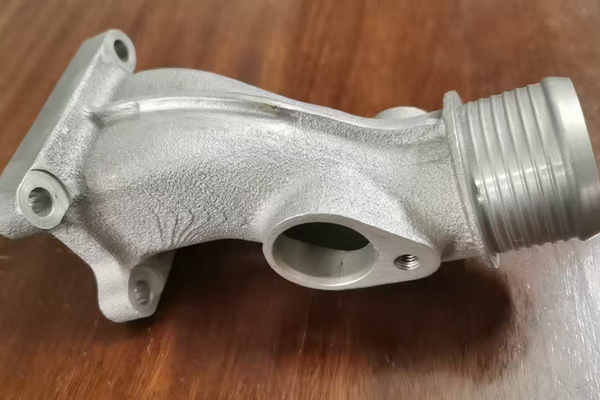
This is where the magic happens. After the sand mold is printed, it undergoes the same time-tested iron casting process. Foundries preheat the mold to remove any remaining moisture or binder residue, then pour molten iron at temperatures exceeding 2,500°F (1,370°C) into the cavity. Because 3D-printed sand molds use similar grain structures and permeability as traditional sand molds, the iron flows cleanly, fills thin walls, and solidifies with excellent metallurgical properties. Once cooled, the sand is broken away, revealing a cast iron component that is ready for machining.

Key Advantages Over Traditional Casting
So why are foundries adopting this technology? The benefits are substantial.
First, tooling elimination is a game-changer. Traditional sand casting requires a wooden or metal pattern for every part. Creating a complex pattern can take weeks or months and cost tens of thousands of dollars. With 3D sand printing, you simply design the part in CAD and print the mold—directly reducing lead times from months to just days.
Second, design freedom soars. Engineers can now design parts for function, not for pattern extraction. Undercuts, internal lattice structures, conformal cooling passages, and complex cores can be printed as a single assembly rather than multiple glued sections. This reduces assembly errors and improves final casting integrity.
Third, iteration is cheap. When a design changes mid-development, a traditional pattern becomes scrap. With sand printing, you simply modify the CAD file and print a new mold overnight. This accelerates prototyping and low-volume production dramatically.
Real-World Applications
This technology is not theoretical. Heavy equipment manufacturers are using 3D sand printing + iron casting to produce hydraulic manifolds with complex internal channels that reduce pressure loss. Automotive restoration shops cast one-off engine blocks for vintage race cars without expensive tooling. Even pump and valve companies print cores that allow iron castings to have curved, self-cleaning fluid passages—impossible to achieve with straight drilled holes.
Another critical application is weight reduction. By designing organic, rib-like internal structures, engineers can reduce the mass of a cast iron component by 20-30% while maintaining strength. In industries like rail or mining equipment, every kilogram saved translates to real energy efficiency.
Limitations to Consider
No technology is perfect. 3D sand printing currently has a higher per-mold cost than high-volume traditional casting. If you need 10,000 identical iron castings, a traditional pattern will likely be cheaper per part. The sweet spot is low-to-medium volume, complex geometries, or rapid prototyping. Additionally, maximum build sizes for industrial sand printers are improving (now exceeding 2 meters in some dimensions), but very large castings may still require traditional methods.
The Future Outlook
Looking ahead, the combination of 3D sand printing and iron casting is poised for growth. Hybrid workflows are emerging: printing only the complex core while using traditional molds for the outer shape. Binder formulations are becoming more environmentally friendly, producing fewer gases during iron pouring. And as printer speeds increase and material costs drop, the break-even point will shift toward higher volumes.
For foundries willing to invest, the message is clear. 3D sand printing does not replace the ancient craft of iron casting—it liberates it. Designers are no longer constrained by draft angles, parting lines, or tooling costs. They can finally ask: What shape would this iron part be if I could build any sand mold I can imagine?
The answer is a new generation of cast iron components: lighter, smarter, and delivered in days instead of months. That future is already being printed, one sand layer at a time.


