

Unlocking the Potential of Titanium Machining Components
In the world of prototype manufacturing, few materials command as much respect—or present as much of a challenge—as titanium. For engineers, product developers, and manufacturing specialists, titanium machining components represent the pinnacle of precision engineering. Whether you are developing aerospace parts, medical implants, or high-performance automotive prototypes, understanding the nuances of working with this remarkable metal is essential for transforming a conceptual design into a functional reality.
Why Titanium? The Demand for Excellence
Before diving into the machining process, it is crucial to understand why titanium is so highly sought after for prototype and end-use components. Titanium offers a unique combination of properties that is unmatched by most other metals.
First, its strength-to-weight ratio is exceptional. Titanium is as strong as steel but approximately 45% lighter, making it ideal for applications where reducing mass without sacrificing structural integrity is critical. Second, it possesses outstanding corrosion resistance. Unlike stainless steel, titanium forms a passive oxide layer that protects it from harsh chemicals, saltwater, and bodily fluids, which is why it is the gold standard for medical implants. Finally, it maintains its mechanical properties at high temperatures, often outperforming aluminum and steel in thermal stability.
For prototype manufacturers, these properties mean that a titanium component machined today can accurately represent the performance of a final production part, allowing for rigorous testing under real-world conditions.
The Machining Challenge: Heat, Hardness, and Tooling
If titanium’s properties are a blessing for the end-user, they are a curse for the machinist. Titanium machining components require a fundamentally different approach than machining aluminum or standard steel. The primary challenge lies in titanium’s low thermal conductivity.
Unlike aluminum, which dissipates heat quickly through chips and into the coolant, titanium traps heat in the cutting zone. This concentrated heat causes work hardening; as the tool cuts, the surface of the material becomes harder, leading to premature tool failure if not managed correctly. Additionally, titanium’s high "shear strength" means that cutting forces are concentrated very close to the cutting edge, increasing the risk of chipping.
To overcome these obstacles, precision is non-negotiable. Successful titanium machining relies on using sharp, positive-rake geometries with carbide tooling coated for heat resistance (such as AlTiN or TiAlN coatings). Rigidity is also paramount—both the machine tool and the workpiece must be securely fixed to eliminate vibration, which can lead to catastrophic tool failure.
Key Strategies for Precision Prototyping
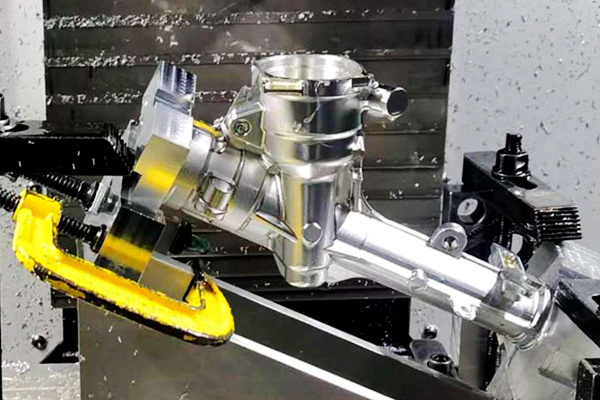
When producing titanium machining components for prototypes, the workflow differs significantly from mass production. In prototyping, flexibility and accuracy take precedence over cycle time. Here are the key strategies we employ in our facility to ensure success:
1. Strategic Tool Paths
Traditional milling strategies that bury the tool in the material are a recipe for failure with titanium. Instead, we utilize high-efficiency milling (HEM) toolpaths. These paths maintain a constant chip load and utilize the entire flute length of the tool, reducing radial engagement while maintaining high feed rates. This technique minimizes heat generation and prevents work hardening.
2. Coolant Management
Flood coolant is not just a luxury when machining titanium; it is a necessity. High-pressure coolant (often exceeding 1,000 PSI) is used to evacuate chips instantly. If chips are not cleared, they can be re-cut, leading to surface defects and tool breakage. For deep cavity work, through-spindle coolant is essential to ensure that the cutting edge remains lubricated.
3. Maintaining Tight Tolerances
One of the reasons clients choose titanium for prototypes is to validate fit and function. Titanium has a tendency to “spring back” due to its elasticity. We account for this in the programming phase, often employing multiple finishing passes to achieve the precise tolerances—sometimes as tight as ±0.0005 inches—required for mating components in aerospace or medical assemblies.
Surface Finish and Post-Processing
The journey of titanium machining components does not end when the mill stops. Surface finish is critical, particularly for medical implants where biocompatibility is key, or for consumer products where aesthetics matter.
As-machined titanium has a uniform, matte gray finish. However, many prototypes require post-processing to meet design specifications. Common secondary operations include:
· Chemical Milling: Used to remove the recast layer or alpha case that may form during machining.
· Hand Finishing and Polishing: To achieve a smooth, mirror-like surface that reduces friction and improves wear resistance.
· Anodizing: A popular option for prototypes, anodizing creates a decorative oxide layer without adding thickness, allowing for color-coding of different components in an assembly.
The Future of Titanium Prototyping
As industries push toward greater efficiency and durability, the demand for titanium machining components in the prototyping phase is only set to grow. Advances in multi-axis CNC technology and hybrid manufacturing (combining additive manufacturing with subtractive finishing) are making it possible to create complex titanium geometries that were once considered unmachinable.
For product development teams, partnering with a prototype shop that understands the metallurgy and tooling strategies of titanium is not just about getting a part made—it is about getting a part that works exactly as intended under stress. When executed correctly, a machined titanium prototype provides the confidence needed to move from the drawing board to full-scale production.
In the precision-driven world of handcrafted prototypes, titanium remains the ultimate test of skill. By respecting the material’s properties and employing advanced machining strategies, we continue to turn one of the world’s toughest metals into the finely detailed components that power tomorrow’s innovations.


