

The Critical Role of CNC Machining in Modern Prototype Development
In the accelerating race from concept to market, the prototype is the tangible bridge between abstract digital design and physical reality. While additive manufacturing has captured significant public imagination, Computer Numerical Control (CNC) machining remains the undisputed gold standard for functional prototyping. It is the process that delivers not just a shape, but a material truth—a part that behaves, responds, and fails exactly as its production-line counterpart will. For engineers and product developers, CNC machining is not merely a method of material removal; it is a strategic discipline that validates design for manufacturability (DFM) long before the tooling budget is approved.
The Material Imperative
The most profound advantage of CNC prototyping lies in its material fidelity. 3D printing often produces parts with anisotropic properties, meaning they are weaker along the layer lines. CNC machining, conversely, carves prototypes from solid billets of wrought or cast material—be it 6061-T6 aluminum, 316L stainless steel, PEEK, or titanium. This "subtractive" process preserves the original grain structure of the metal or polymer, ensuring that the prototype exhibits the exact thermal conductivity, tensile strength, and fatigue resistance of the final production part. When an automotive engineer tests a CNC-machined engine block prototype under 500°F thermal cycling, they are validating the material science, not just the geometry. This data is irreplaceable; it allows for accurate finite element analysis (FEA) correlation, ensuring that simulation models align with real-world physical responses.
Geometric Precision and Surface Integrity
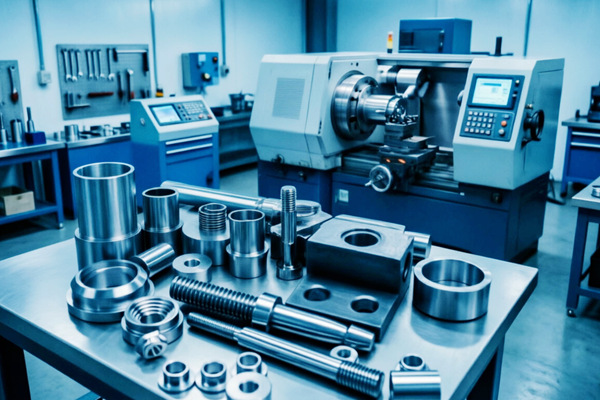
In the lexicon of manufacturing, tolerances dictate success. CNC machining achieves standard positional tolerances of ±0.005 inches, with high-end 5-axis machines routinely holding ±0.0002 inches on critical features. For prototype industries—particularly aerospace and medical devices—this precision is non-negotiable. A surgical guide prototype must locate bone screws within a fraction of a millimeter; a turbine blade prototype requires leading-edge radii that conform strictly to aerodynamic simulations. Furthermore, the surface finish achievable through CNC milling, typically 32 µin Ra or better, often eliminates the need for secondary polishing in the prototype phase. This "as-machined" finish provides immediate feedback on toolpath strategies, chip evacuation, and clamping forces, offering a diagnostic window into potential production issues that would otherwise emerge only during high-volume runs.
Agility Through Digital Integration
The modern CNC prototype process is a symphony of digital and physical workflows. The journey begins with Computer-Aided Design (CAD), transitions through Computer-Aided Manufacturing (CAM) software to generate toolpaths, and culminates in the G-code that directs the spindle. This digital thread is flawless in its repeatability. Should a design flaw be detected during physical testing—a stress riser at a sharp internal corner, for instance—the engineer modifies the CAD file, regenerates the toolpath, and machines a revised prototype within hours. This rapid iteration cycle, often termed "rapid machining," collapses traditional development timelines from months to weeks. For complex assemblies, modern multi-axis CNC centers can complete a one-piece prototype in a single setup, eliminating the errors associated with repositioning and ensuring geometric consistency across all critical datums.
The Economies of Scale Paradox
Contrary to popular belief, CNC machining is not solely reserved for high-volume production. For prototype runs ranging from a single unit to 500 pieces, CNC is remarkably cost-effective. The primary investment lies in programming and setup, not in hard tooling like injection molds or stamping dies. This makes the "per-part" cost relatively stable, allowing engineers to iterate aggressively without the financial penalty of scrapping expensive molds. The versatility of CNC tooling—with a standard shop capable of holding hundreds of end mills, drills, and taps—means that a single machine can transform a block of aluminum into a gear, a housing, or a manifold without changing the fundamental workflow. This flexibility ensures that prototype departments can pivot instantly between projects without the downtime associated with mold changes.
Navigating the Challenges
Despite its strengths, CNC prototyping is not a panacea. The process is inherently subtractive, meaning it generates significant material waste—a key concern for expensive alloys. Furthermore, internal geometries are restricted by tool access; deep cavities and undercuts require specialized lollipop cutters or multi-axis indexing, which drive up programming time. Designers must remain acutely aware of the "tool-to-part" interference zones. However, these constraints are precisely what make CNC invaluable as a DFM tool. If a prototype cannot be machined, it likely cannot be cast or forged effectively. The challenges of CNC prototyping force engineers to design for real-world manufacturability, filtering out "digital fantasies" that look perfect on a screen but are impossible to produce economically.
The Convergence with Additive Manufacturing
The future of prototyping is not a battle between subtractive and additive manufacturing, but a strategic partnership. Increasingly, prototype shops use CNC machining to finish 3D-printed near-net shapes. This hybrid approach leverages the geometric freedom of printing for complex internal lattices, while employing CNC to machine precise mating surfaces, threaded holes, and bearing journals. This synergy maximizes material utilization while ensuring critical interfaces maintain the tight tolerances that only subtractive machining can provide.
Conclusion
CNC machining for prototyping is an exercise in disciplined engineering. It is the rigorous process of translating digital intent into physical reality while respecting the limitations of physics, tooling, and metallurgy. It provides the empirical data that simulations cannot—the feel of a bearing fit, the sound of a spindle load, and the microscopic inspection of a finished wall. As Industry 4.0 technologies embed sensors into CNC spindles and integrate closed-loop quality control, the prototype phase becomes ever more predictive. In this evolution, the CNC machine remains the cornerstone: a testament to the fact that, in manufacturing, true innovation is built not by adding material, but by removing everything that is not the part.


