

How Low-Volume Manufacturing Redefines Agility in a High-Volume World
In the industrial psyche, efficiency has long been synonymous with scale. The prevailing logic, forged in the fires of the Fordist era, dictates that high volume drives down unit cost, justifying the monumental expense of hard tooling and dedicated assembly lines. However, as the global economy fragments into niches and the demand for hyper-customization surges, a quiet revolution is underway. This revolution is not found in the sprawling megafactories of the East, but in the adaptable workshops and CNC machining centers dedicated tolow-volume manufacturing. Far from being a compromise, low-volume production—specifically through rapid prototyping and "handboard" (or prototype) machining—has emerged as a strategic imperative. It offers a synthesis of flexibility, precision, and speed that challenges the very notion that bigger is always better.
The Fluidity of Form: Unmatched Flexibility
The primary advantage of low-volume manufacturing is its inherent flexibility. Traditional mass production relies on injection molds and stamping dies that are expensive to produce and time-consuming to modify. A design change that requires a new mold can cost hundreds of thousands of dollars and set production back by months.
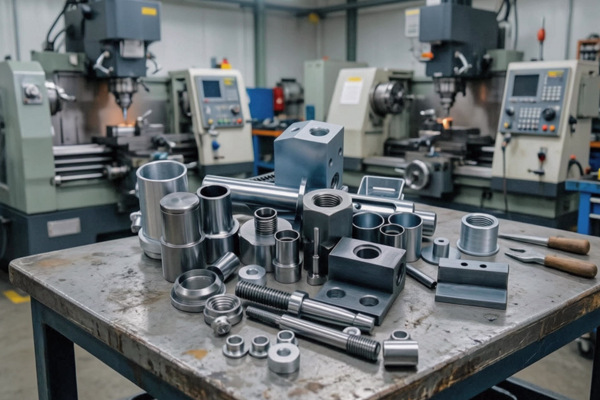
In contrast, the handboard or prototype shop operates on a philosophy of subtractive and additive agility. Using advanced 3- to 5-axis CNC milling machines, these shops can produce a complex part from a solid block of metal or plastic in a matter of hours or days. This process is "tool-less" in the traditional sense; the tool is the software and the cutter, not a hardened steel cavity. This allows engineers to iterate rapidly. If a stress analysis reveals a weak point in the geometry, the CAD file is adjusted, a new G-code is generated, and a revised part is on the machine within the hour.
This flexibility extends to material selection. A large-scale foundry might be locked into a specific aluminum alloy to suit its casting process. A low-volume machine shop, however, can effortlessly switch from machining aerospace-grade Titanium to engineering plastics like PEEK or Delrin on the same machine bed. This adaptability allows design teams to test multiple materials against the same geometry, optimizing for weight, strength, or chemical resistance without the commitment of a massive capital expenditure. It de-risks the innovation process, allowing companies to "fail fast and learn faster" without the financial hangover of scrapped tooling.
The Micro and the Macro: Precision and Control
Perhaps the most pervasive myth regarding low-volume manufacturing is that it is inherently less precise than mass production. The reality, however, is quite the opposite. In a hard-tooled injection mold, the machinist must predict the shrinkage of the plastic, the warp of the cooling process, and the deflection of the tool itself. These variables often require extensive "try-out" runs to dial in, and even then, tolerances usually settle around +/- 0.1mm.
For modern CNC machining centers dedicated to prototype and low-volume work, precision is the baseline. A high-end machining center operating in a climate-controlled environment can routinely achieve tolerances of +/- 0.005mm to +/- 0.01mm— a level of accuracy that is often superior to many casting or forging processes. This is the"digital directness"of subtractive manufacturing. The machine follows the digital blueprint with a fidelity that leaves little to the interpretation of thermal dynamics or material flow.
Furthermore, the handboard process offers superior control overgeometric dimensioning and tolerancing (GD&T). When producing 10 or 50 parts for a mission-critical assembly—such as a surgical instrument or a robotic actuator—each part can be inspected and verified on a Coordinate Measuring Machine (CMM). In high-volume runs, statistical process control is used to spot trends and prevent drift; the focus is on keeping 99.9% of parts within the specification. In low-volume, there is no "margin for error" on the bell curve. Each part is a critical asset, often requiring 100% inspection. This rigorous control ensures that every component fits perfectly into the larger assembly, eliminating the "stack-up" of tolerances that can plague high-volume components which have been approved via batch sampling.
Speed to Market: The Velocity of Innovation
In the modern economy, time is often the most expensive currency. The lead time for an injection mold is typically 8 to 12 weeks; adding modifications, that timeline often stretches to 4 months. For a company trying to capture a seasonal market or a technological window, this is a death sentence.
Low-volume manufacturing compresses this timeline into days.The efficiency of the handboard approach is not just about the cutting speed of the spindle, but about the elimination of supply chain friction. It reduces the "handshake" process between design and production. Since there is no need for tooling vendors, mold-flow analysts, or lengthy sampling procedures, the feedback loop between the CAD designer and the manufacturing floor is virtually instantaneous.
This high-speed efficiency is critical during the final stages of product development. When a product is ready for clinical trials, user testing, or beta deployment, there is a pressing need for "looks-like, works-like" parts. These parts must be chemically resistant, structurally sound, and dimensionally exact to ensure the test data is valid. Low-volume manufacturing provides these functional prototypes that are indistinguishable from the final production part—except they are available in 3 weeks rather than 3 months. This speed allows companies to validate their market, fix unforeseen issues, and make real-world adjustments, ultimately resulting in a more robust and mature product by the time the high-volume tooling is eventually commissioned (if it is ever commissioned at all).
The Economic Frontier: The Case for "10 Percent" Manufacturing
From a financial standpoint, the cost-per-part economics of low-volume manufacturing are often misinterpreted. Yes, the unit cost of a CNC-machined part may be higher than that of a molded part. However, this comparison ignores the total cost of ownership.
When considering the cost of high-volume tooling, the cost of warehousing thousands of units, and the risk of obsolescence, low-volume manufacturing becomes incredibly competitive. It allows for "Just-in-Time" (JIT) production on a granular scale. Companies no longer need to maintain expensive inventory; they can order a batch of 50 to 100 units and replenish as demand dictates. This cash-flow efficiency is particularly vital for aerospace, medical, and defense industries, where product life cycles are long, but design changes are frequent.
Moreover, the "handboard" approach allows for complexity without penalty. In injection molding, draft angles are required to eject the part; in CNC machining, undercuts and deep ribs are just a matter of tool path strategy. This means designers can create more efficient, lightweight structures without being constrained by the "pull direction" of a mold. The machine merely goes where the tool can reach, enabling a form of"free-form precision"that is impossible in traditional high-volume contexts.
Conclusion
As we move deeper into an era defined by Industry 4.0 and the "lot size of one," the rigid, monolithic nature of high-volume production is increasingly out of step with the needs of modern engineering. Low-volume manufacturing, rooted in the craft of the handboard but executed with the rigor of high-precision CNC machining, offers a vital antidote. It bridges the gap between the abstract digital design and the tangible physical object with an unmatched combination of flexibility and rigor.
It delivers the precision of a Swiss watch, the speed of a racing pit crew, and the economic viability required for a startup or a blue-chip multinational launching a limited-edition product. By accepting the "precision paradox"—that smaller runs can yield higher precision and greater control—we unlock a manufacturing strategy that is not just a stop-gap, but a superior methodology for the most complex and critical challenges of the 21st century. In the world of high-stakes engineering, the future belongs to the flexible, and the flexible is found in the low-volume shop.


