

Rapid Prototype Machining: Mastering Complex Parts with Precision CNC Manufacturing
In the fast-paced world of modern manufacturing, speed and precision are not just advantages—they are absolute necessities. For engineers and product designers working on intricate components, rapid prototype machining has emerged as the gold standard for bridging the gap between digital concepts and tangible, functional reality. Unlike traditional mass production methods that require lengthy tooling setups, rapid machining leverages advanced Computer Numerical Control (CNC) technology to deliver high-fidelity prototypes in record time.
The Power of Subtractive Manufacturing for Complex Geometries
Rapid prototype machining is fundamentally a subtractive manufacturing process. It involves taking a solid block of engineering-grade material—such as aluminum, stainless steel, titanium, or rigid plastics—and precisely removing material to achieve the desired shape.
For complex parts, this method offers distinct benefits over additive manufacturing (like 3D printing). While 3D printing excels at creating organic shapes, CNC machining provides superior mechanical properties because the prototypes are carved from homogeneous, isotropic materials. This means the strength, thermal resistance, and chemical stability of a machined prototype are identical to those of a final production part. When dealing with tight tolerances, intricate internal channels, or demanding functional tests, rapid machining ensures that the prototype performs exactly as intended under real-world stress.
Accelerating Product Development Cycles
One of the most significant impacts of rapid machining is the drastic reduction in lead times. Traditional manufacturing workflows often involve weeks or even months dedicated to designing and fabricating molds. In contrast, rapid machining transitions directly from a CAD (Computer-Aided Design) model to a finished part.
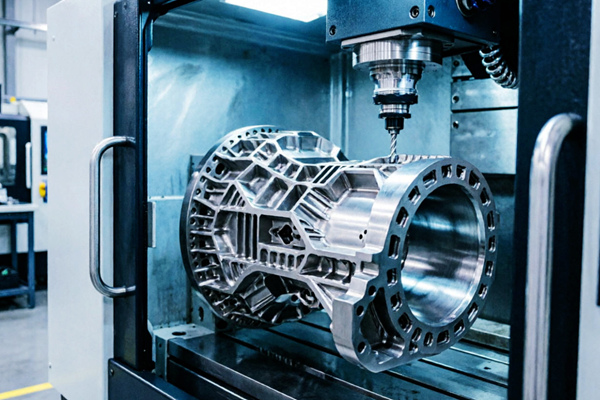
By automating the process planning and utilizing multi-axis CNC mills (such as 3-axis, 4-axis, and advanced 5-axis machines), manufacturers can produce highly complex geometries in a single setup. This agility allows engineering teams to:
Validate Designs Early: Test form, fit, and function immediately.
Iterate Quickly: Make design changes based on physical feedback without incurring massive re-tooling costs.
Reduce Risk: Identify potential failures in the prototyping phase rather than during mass production.
Material Versatility and Engineering Excellence
A key advantage of rapid prototype machining is the sheer breadth of compatible materials. Manufacturers are not limited to proprietary plastic resins; they can choose from the exact alloys required for the final application.
For industries like aerospace and automotive, where performance is non-negotiable, this is critical. A turbine blade prototype, for instance, requires specific nickel-based superalloys to withstand extreme heat, while medical implants demand biocompatible titanium. Rapid machining services can accommodate these specialized materials, ensuring that the prototype undergoes rigorous testing under authentic conditions. Furthermore, machined parts boast excellent surface finishes and dimensional accuracy, making them suitable for use as end-use parts in low-volume production runs.
Overcoming Challenges in Complex Part Fabrication
Creating complex parts via rapid machining does present challenges, such as tool access to deep cavities or undercuts. However, advancements in CAM (Computer-Aided Manufacturing) software and 5-axis indexing have largely mitigated these issues. Modern CNC systems can approach the workpiece from virtually any angle, allowing for the creation of freeform surfaces and complex internal structures that were previously impossible to machine efficiently. Additionally, automated fixturing and sacrificial support structures ensure that even the most delicate features remain stable during the cutting process.
Conclusion: The Future of Agile Manufacturing
As industries continue to demand faster innovation cycles and higher performance standards, rapid prototype machining stands out as an indispensable tool. It empowers manufacturers to push the boundaries of design complexity without sacrificing material integrity or timeline constraints. By integrating digital precision with robust subtractive processes, rapid machining is not just about making models—it is about accelerating the path to market-ready, high-performance products.
Whether for validating a new aerospace component or producing a small batch of custom medical devices, investing in rapid prototype machining is a strategic move toward greater efficiency and engineering excellence.


