

Rapid Prototyping and Custom Metal Fabrication of Electronics Enclosures
Electronic systems rarely succeed on circuitry alone. The metal enclosure surrounding a printed circuit board governs electromagnetic compatibility, thermal performance, mechanical survivability, and user perception. In fast-turnaround manufacturing, the enclosure has therefore become a parallel engineering problem rather than an afterthought. Rapid prototyping and custom metal fabrication now allow design teams to move from a 3D model to a functional metal housing in days, compressing the traditional enclosure development cycle without sacrificing the precision that modern electronics demand.
Why Metal Still Matters
Polymer enclosures dominate consumer electronics, but metal remains irreplaceable in applications where shielding, heat dissipation, or structural rigidity is critical. Aluminum, steel, stainless steel, copper, and brass each bring distinct advantages. Aluminum offers an excellent strength-to-weight ratio and thermal conductivity, making it the default choice for RF modules, industrial controllers, and power electronics.
Stainless steel provides corrosion resistance and durability for medical, marine, and food-processing equipment. Copper and its alloys are reserved for applications requiring superior EMI attenuation or electrical grounding. The choice of alloy directly influences manufacturability, finish options, and cost, so material selection should be treated as an early design decision rather than a procurement detail.
The Role of Rapid Prototyping
Rapid prototyping serves two purposes in enclosure development: validating form, fit, and function before committing to tooling, and generating production-intent parts when volumes are low or schedules are aggressive. Sheet metal prototyping, CNC machining, and laser cutting allow engineers to test wall thickness, mounting boss placement, connector cutouts, and assembly tolerances with real hardware. A prototype that can be assembled, dropped, thermally cycled, and electrically tested reveals problems that simulation may miss—interference between a connector and a lid, for example, or a vent pattern that fails to move enough air.
Core Custom Fabrication Processes
Several processes dominate custom metal enclosure manufacturing, and each suits different geometries and volumes.
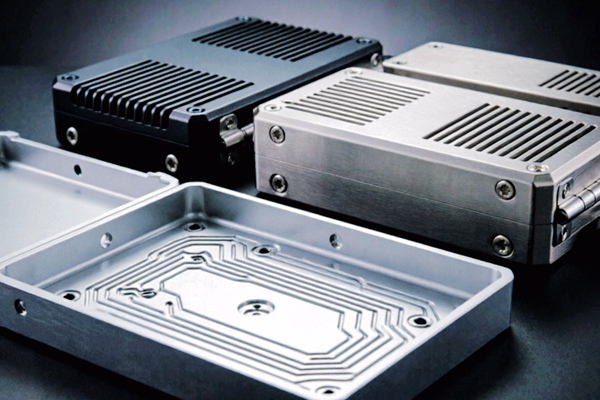
CNC machining produces enclosures with tight tolerances, complex internal features, and excellent surface finish. It is ideal for small to medium quantities, prototypes, and designs with pockets, threads, and sealing grooves that sheet metal cannot easily replicate.
Sheet metal fabrication—laser cutting, punching, bending, and welding—is the workhorse for box-like enclosures. Progressive or compound tooling supports higher volumes, while press brake forming handles low-volume runs economically. Stamped and formed enclosures are lightweight, cost-effective, and easy to integrate with mounting flanges and ventilation features.
Die casting and extrusion serve higher-volume programs. Extruded aluminum profiles yield constant cross-section enclosures with integrated heat sinks, while die casting enables complex, near-net-shape housings with minimal machining. For rapid prototyping, however, CNC and sheet metal usually deliver the fastest path to a functional part.
Design Considerations for Manufacturability
Design for manufacturability (DFM) determines whether a good concept becomes a producible enclosure. Generous bend radii, consistent wall thickness, and clearance for tooling reduce cost and lead time. EMI performance depends on seam continuity, gasket selection, and grounding points; a well-designed enclosure treats these as electrical features, not cosmetic ones. Thermal management may require vents, heat-spreading bosses, or direct contact between the PCB and the enclosure wall. IP-rated sealing demands careful attention to gasket grooves, fastener spacing, and surface flatness. Finally, finishes—anodizing, powder coating, passivation, or plating—affect both durability and conductivity, and should be specified with the same rigor as the base material.
From Prototype to Production
The most efficient programs use a staged approach. Initial prototypes validate geometry and assembly. Second-generation parts incorporate thermal and EMI testing, often using the same fabrication process intended for production. Once the design stabilizes, tooling or dedicated fixtures are introduced, and finishing and assembly processes are qualified. This progression reduces the risk of costly redesigns and shortens the overall development timeline.
Conclusion
Metal enclosures are no longer passive boxes. They are engineered components that influence electrical performance, thermal behavior, and product reliability. Rapid prototyping and custom metal fabrication give design teams the ability to iterate quickly, test honestly, and transition to production with confidence. In a market where electronics evolve faster than traditional tooling cycles, the ability to prototype and manufacture precision metal enclosures rapidly is not merely a manufacturing advantage—it is a competitive necessity.


