

Critical Role of CNC Machining in Aerospace Metal Components
When we look up at an aircraft soaring through the clouds, we often marvel at the engineering marvel of flight. However, what we don’t see is the intricate skeleton that makes that journey possible—the thousands of metal components working in perfect harmony. In the world of aerospace manufacturing, there is no room for error. This is where CNC machining aerospace parts transitions from a manufacturing process into an art form defined by micron-level accuracy and absolute reliability.
Why Metal Still Rules the Skies
In the realm of aviation and space exploration, the materials selected must endure extreme temperature fluctuations, immense mechanical stress, and the relentless pursuit of weight reduction. While composite materials have gained attention in recent years, metal components remain the backbone of critical structures. Specifically, aluminum parts dominate the aerospace landscape. Alloys such as 6061-T6 and 7075-T6 are the industry’s workhorses, prized for their exceptional strength-to-weight ratio, corrosion resistance, and fatigue strength.
The CNC Advantage: Precision Beyond Compromise
Why does CNC machining remain the undisputed method for producing these aluminum parts? The answer lies in the nature of aerospace requirements. Unlike consumer goods where aesthetics sometimes trump function, aerospace components demand structural integrity that cannot be compromised. CNC machining offers the repeatability and precision necessary to create complex geometries that would be impossible to achieve through conventional casting or manual fabrication.
When a CNC milling machine begins to carve a billet of aluminum, it is doing more than just removing material; it is sculpting a safety-critical component. Whether it is a wing spar, a hydraulic manifold, or a structural bracket, every metal component must pass rigorous non-destructive testing. The chips produced during machining tell a story of tight tolerances—often held to within +/- 0.0005 inches. In this industry, a deviation smaller than the width of a human hair can mean the difference between a part that flies and one that fails.
Mastering the Material: Aluminum in Focus
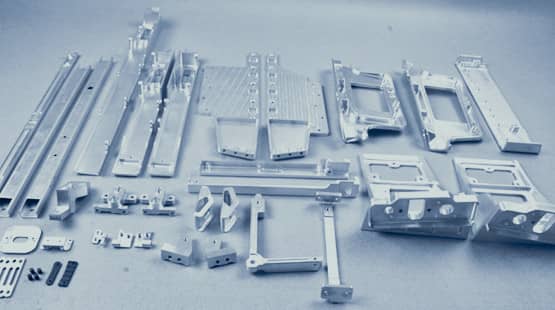
Working with aluminum parts at this level requires a deep understanding of material behavior. Aerospace-grade aluminum is notoriously "gummy" if machined with incorrect parameters. Professional machinists must master chip evacuation to prevent built-up edges, which can compromise surface finishes. Moreover, the internal stress relief in large aluminum forgings is a critical consideration. A skilled CNC programmer knows that removing too much material from one side of a billet too quickly can release internal stresses, causing the metal component to warp and fall out of tolerance. This is why techniques like roughing, stress-relieving, and finishing passes are meticulously planned.
Beyond Aluminum: The Role of Exotic Metals
Beyond aluminum, the CNC machining of other exotic metal components such as titanium, Inconel, and stainless steel also plays a vital role in aerospace. While these materials are heavier and more difficult to cut, they are essential for high-temperature applications like engine mounts and exhaust systems where aluminum would soften. However, the sheer volume of structural workhorses remains in the aluminum family. From the fuselage frames to the wing ribs, aluminum parts constitute a significant percentage of an aircraft’s airframe.
The 5-Axis Revolution: Complexity Made Possible
The future of CNC machining for aerospace is evolving with the advent of 5-axis technology. Modern aerospace metal components are no longer simple blocks; they are organic, complex structures designed by generative engineering software to minimize weight while maximizing strength. 5-axis CNC machines allow manufacturers to produce these complex aluminum parts in a single setup. This not only improves accuracy by eliminating multiple fixture errors but also reduces lead times—a critical factor in an industry where supply chain efficiency directly impacts aircraft delivery schedules.
Finishing Strong: Surface Treatments Matter
Furthermore, surface treatment is an integral part of the process. Once the metal components are machined, they often undergo anodizing or chemical conversion coating. For aluminum parts, this is not merely cosmetic. These treatments enhance corrosion resistance—a vital characteristic for aircraft that operate in high-altitude, moisture-rich environments—and provide a suitable base for adhesives if the part is to be bonded to other structures.
Conclusion: Precision Is a Promise
In conclusion, while digital technology and automation continue to advance the aerospace sector, the physical reality of flight still depends on the integrity of machined metal. CNC machining aerospace parts, particularly aluminum parts, represents the intersection of human ingenuity and mechanical precision. For those of us in the handcrafted prototype and manufacturing industry, every swarf of aluminum removed is a step toward ensuring that what we build today will safely navigate the skies tomorrow.
Whether you are prototyping a new aviation bracket or scaling up for full-rate production, the fundamentals remain the same: respect the material, trust the process, and never compromise on the quality of your metal components. In aerospace, precision isn’t just a specification—it’s a promise.


