

Aerospace-Grade Metal Parts in Multi-Industry Prototyping and Production
When we hear“aerospace-grade metal parts,”minds instinctively drift to jet engines and fuselage frames. But that mental picture is decades out of date. Today, the same rigorous standards, exotic alloys, and validation protocols developed for supersonic flight have quietly migrated into industries that never leave the ground—yet face equally punishing demands.
This isn’t about simply“using better materials.”It’s about a fundamental shift in how engineers across sectors approach prototyping, failure prevention, and lifecycle certainty. And at the heart of this shift lies a symbiotic pair: high-precision CNC machining & fabrication, backed by ISO certified quality for demanding industries.
The Hidden Spread of Aerospace Metallurgy
Consider the last time you rode an autonomous shuttle, watched a robotic surgical arm pivot, or charged an electric vehicle at a roadside cabinet. Inside each—often invisible—are components machined from Inconel, titanium 6Al-4V, or heat-treated stainless alloys originally formulated for turbine blades or landing gear.
Why? Because the physics of failure doesn’t respect industry boundaries. A high-speed train’s braking actuator experiences thermal shock similar to a reentering spacecraft’s control surface. A deep-sea sensor housing faces corrosion pressures that rival an aircraft’s wing flap mechanism in salty atmospheres. And a battery housing for grid storage must manage heat dissipation curves eerily similar to avionics enclosures.
Engineers have caught on. Instead of maintaining separate material libraries for“automotive,” “medical,”and“defense,”they now default to aerospace-grade specifications—because certifying once for the toughest environment covers all others below that threshold.
Where Prototyping Meets Reality: The CNC Difference
Prototyping is supposed to be forgiving. Plastic, rapid tooling, additive-only approaches—these have their place in form-and-fit testing. But functional validation of metal parts under real loads, temperatures, and vibration profiles demands something else entirely.
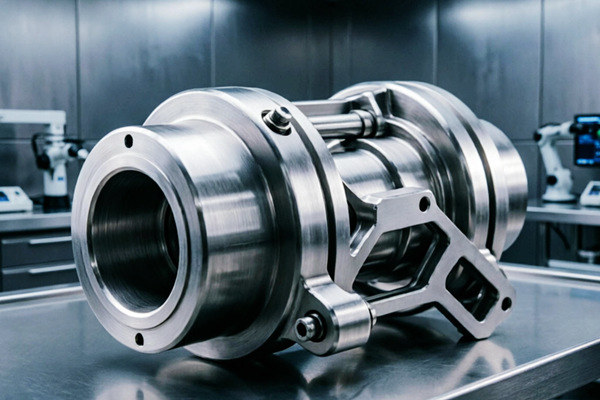
This is where high-precision CNC machining & fabrication becomes non-negotiable. Unlike casting or even advanced metal 3D printing (which often requires post-machining anyway), multi-axis CNC processes deliver three irreplaceable advantages for demanding prototypes:
Material integrity preserved–No porosity, no micro-cracks from rapid solidification. The part’s metallurgy matches the final production batch perfectly.
Sub-micron feature fidelity–When a valve seat must seal against 15,000 psi of hydrogen, a 5-micron deviation means explosive failure. CNC holds tolerances that would make a Swiss watchmaker nod in approval.
Rapid iteration with zero tooling amortization–Change a CAD parameter at 9 AM; hold the revised metal part at 4 PM. For energy, medical, or autonomous vehicle startups, that speed collapses months of supply-chain delay.
I recall a conversation with a lead engineer at a geothermal drilling startup. Their downhole telemetry housing kept failing at 260°C—not because the design was flawed, but because prototype castings had unpredictable grain structure. Switching to 5-axis CNC from aerospace-grade 718 Inconel eliminated the failure in two weeks.“We stopped prototyping metal parts like consumer goods,”he said.“We started treating every iteration like a flight-critical component.”
The ISO Certification Backstop: Not a Sticker, a Process
In industries where failure can trigger lawsuits, environmental disasters, or human injury,“we think it’s probably fine”is an unacceptable specification. That’s why aerospace-grade metal part providers pursue ISO certified quality for demanding industries—but the real value isn’t the certificate on the wall.
It’s the traceability chain.
An ISO 9001:2015 or AS9100D (aerospace-specific) system forces documentation at every node: mill certificates for raw stock, tool wear logs, in-process inspection reports, non-destructive test results, and final CMM data. For the prototype engineer, this means two things:
Root cause analysis actually works. When a prototype fails, you can trace the failure to a specific batch of material, a worn end mill, or a coolant concentration shift—not guess blindly.
First-article inspection becomes production-ready. A prototype machined under an ISO-certified system can serve as the production qualification article. No second“commercialization”re-validation. That single fact often cuts 3–6 months from medical or energy product launch timelines.
One medical robotics firm I worked with learned this painfully. Their first-generation surgical drill guide—machined beautifully but without certified process controls—passed functional tests but failed regulatory audit because the material provenance was“a spreadsheet.”The redesign, moved to an AS9100-certified CNC shop, sailed through. The metal was identical. The process was not.
Industries Now Riding the Aerospace Metal Wave
Let’s walk through three non-obvious sectors:
Energy storage & hydrogen systems–High-pressure fittings, burst disks, and heat exchangers machined from 316L or 625 Inconel. Leakage rates below 1×10⁻⁹mbar·L/s are routine—demands straight from rocket propulsion manuals.
Autonomous off-road vehicles–Agricultural and mining robots encounter vibration, abrasive dust, and temperature swings that mimic unpaved airstrip conditions. Their suspension links and sensor mounts now follow aerospace alloy specs.
Implantable device tooling–Not the implants themselves (different regulatory path), but the reusable surgical instruments and trial components. These see repeated sterilization cycles, mechanical fatigue, and absolutely zero tolerance for galling or corrosion. Think 17-4 PH stainless, CNC’d to mirror finishes.
The One Mistake Still Made
Even experienced teams slip. They treat aerospace-grade metal parts as a simple bill-of-materials swap—replace 6061 aluminum with 7075, call it done. But the real leverage comes from redesigning for the material’s strengths: thinner walls, integrated cooling channels, elimination of fasteners via precision alignment features.
When you move to high-precision CNC machining & fabrication, don’t just substitute alloys. Reimagine the assembly. Aerospace thinking means reducing part count, embedding functionality, and designing for inspection as much as for load paths.
Final Pass: Why This Matters Beyond the Shop Floor
We stand at an intersection where the cost of high-end CNC machining has fallen (thanks to automation and tooling advances) while the cost of failure has skyrocketed—in liability, downtime, and brand trust. Aerospace-grade metal parts, once the guarded secret of defense primes, are now accessible to any engineering team willing to respect the process.
That process starts with ISO certified quality for demanding industries as the floor, not the ceiling. It runs through precision CNC as the enabler. And it ends with a prototype that isn’t just“good enough for testing,”but already qualified for the extreme edge of real-world operation.
The next time you design a part for 200°C, high-cycle fatigue, or corrosive fog, ask yourself: Would this fly? If the answer is yes, you’re already thinking at the right altitude.


