

The Engineering Mastery Behind Rapid Sheet Metal Services
In the high-stakes arena of modern manufacturing, speed without precision is chaos, and precision without speed is obsolescence. Rapid sheet metal services have emerged as the critical nexus where these two imperatives converge. Far beyond mere cutting and bending, this discipline represents a sophisticated synthesis of material science, computational geometry, and mechanical expertise. For industries ranging from aerospace enclosures to medical device chassis, the ability to transform a flat coil of aluminum or steel into a complex, load-bearing assembly within hours is not a convenience—it is a competitive lifeline. This article explores the technical mastery and operational professionalism that distinguish elite rapid sheet metal providers, dissecting the workflow from digital design to final delivery.
1. Digital Origami: The Art of Virtual Pre-Engineering
The operational workflow begins not on the shop floor, but in the digital vault of CAD/CAM environments. Here, skilled technicians engage in what might be termed "computational origami"—flattening intricate 3D geometries into 2D nesting patterns that minimize waste while accounting for grain direction, spring-back, and heat-affected zones. This initial phase is where expertise separates the competent from the exceptional. A seasoned programmer does not simply input parameters; they anticipate the dialectic between the tool and the metal. They adjust feed rates for the acoustic signature of the material, compensate for the deflection of long-reach tooling, and sequence punch operations to avoid distorting adjacent features. This is tacit knowledge, accumulated over thousands of machine hours, that cannot be replicated by generic algorithms. Advanced simulation software further allows technicians to predict wrinkling or tearing during deep-drawn operations, enabling corrections before a single millimeter of material is consumed.
2. Laser Alchemy: High-Speed Cutting with Surgical Precision
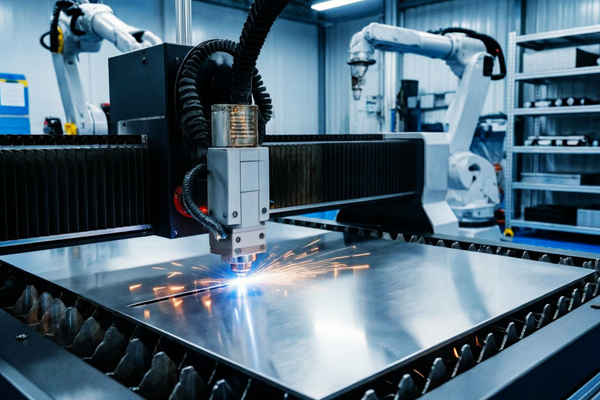
The physical execution of rapid sheet metal work is equally demanding. Contemporary fiber lasers, operating at power levels exceeding 10 kilowatts, can slice through 25-millimeter-thick steel with a kerf width thinner than a human hair. However, the "rapid" moniker is not solely about cut speed; it is about system agility. Automated material storage systems, integrated with robotic loaders, reduce idle time between jobs to mere seconds. Yet, the human element remains irreplaceable during setup. Expert operators perform rigorous "first-off" inspections, employing coordinate measuring machines to verify that hole diameters, bend radii, and flange heights conform to tolerances often measured in thousandths of an inch. They understand that a 0.1-millimeter deviation in a bracket's cut path can cascade into misalignment across a 3-meter assembly. Moreover, technicians must master parameter tuning for reflective materials like copper or brass, adjusting frequency and focal length to prevent back-reflection damage to the laser resonator—a nuance that demands both theoretical knowledge and hands-on intuition.
3. The Bend Doctor: Press Brake Mastery as a Craft
Press brake operations, the most artisanal aspect of the process, demand an almost tactile sensitivity. While modern CNC brakes offer multi-axis backgauges and automatic crowning systems to counteract deflection, the operator’s choice of tooling and tonnage remains decisive. For high-strength alloys, they must calculate the internal radius relative to the material's tensile strength to prevent micro-fractures. They select punch geometries that account for the "oil-canning" effect in thin-gauge metals, ensuring flatness even after repeated impacts. Rapid service providers often maintain libraries of hundreds of specialized tool sets—gooseneck punches for box forms, acute-angle dies for aircraft skins—to obviate the delays of custom fabrication. This readiness allows them to pivot from prototyping a single medical cart frame to a production run of 500 server rack panels without pausing for retooling. The professional's ability to "read" the metal—detecting inconsistencies in hardness or thickness through subtle changes in ram resistance—is a skill honed over decades, transforming a machine operation into a diagnostic dialogue.
4. Secondary Symphonies: Integrating Fasteners, Threads, and Finishes
The professional acumen in this sector extends significantly into secondary processes. Thread-forming, countersinking, and PEM fastener insertion are frequently integrated into the digital job ticket, executed on automated turret presses or robotic cells. Skilled technicians choreograph these sequences to prevent deformation; for instance, they know that installing a 10-millimeter clinch nut must occur before bending, as the deformation from the nut insertion can warp the bend axis. They also manage the subtleties of deburring—employing thermal or electrochemical methods for micro-edges that are invisible to the naked eye but critical for high-voltage electrical busbars. Surface preparation, from media blasting to chem-film application, is scheduled with equal precision, ensuring that corrosion-resistant coatings adhere uniformly without pooling in blind holes. This orchestration of multiple, interdependent operations within a compressed timeline requires rigorous production planning and real-time shop-floor communication—a logistical competence as valuable as any machining skill.
5. Mission-Critical Applications: Where Precision Meets Purpose
Industry applications underscore the gravity of this precision. In electric vehicle battery trays, rapid sheet metal services produce enclosures that must withstand vibration, thermal cycling, and impact forces—all while maintaining dielectric clearances. Here, the technician's expertise in weld-nut placement and seam sealing directly influences fire safety. In semiconductor tooling, these services fabricate vacuum chambers with O-ring grooves requiring surface finishes better than 32 microinches, where even a stray burr can compromise the vacuum integrity. Aerospace ducting demands hydroformed or welded assemblies that endure extreme temperature gradients, requiring meticulous control of heat input during joining. The rapid turnaround—often 24 to 48 hours—enables design engineers to perform destructive testing, iterate geometries, and validate finite element analysis models in real time, compressing what once was a monthly development cycle into a weekly sprint. Each application reinforces that the provider is not merely a vendor, but a risk-mitigation partner.
6. The Professional Ethos: Continuous Calibration and Quality Culture
Ultimately, rapid sheet metal services are not a commodity but a partnership in engineering cognition. The true "speed" lies not in the spindle RPM, but in the accelerated learning loop they enable. Every quick-turn project yields data on bend deductions, kerf compensation, and material spring-back that refines the provider’s internal knowledge base. This cyclical learning, combined with rigorous quality management systems (AS9100 for aerospace, ISO 13485 for medical), creates a culture of continuous improvement. Regular gauge calibration, traceable material certifications, and employee cross-training ensure that institutional knowledge survives personnel transitions. In a world where supply chain velocity determines market relevance, these service shops are the silent accelerators—transforming raw coils into mission-critical components with the quiet confidence of craftsmen who know that in the realm of metal, there is no substitute for skill.
Conclusion: Speed as a Byproduct of Expertise
Rapid sheet metal services are ultimately defined not by how fast machines run, but by how intelligently humans guide them. The integration of advanced automation with seasoned craftsmanship produces a manufacturing ecosystem where prototypes mirror production quality, and design iterations occur at the speed of thought. As industries push toward lighter, stronger, and more complex geometries, the demand for such specialized proficiency will only intensify. In this domain, velocity is not the goal—it is the natural outcome of deep material understanding, precise process control, and an unwavering commitment to professional excellence.


